
Nestle, Titan, ICICI Bank, Tata Steel, IndusInd Bank, ITC, JSW Steel and State Bank of India were the other laggards. Among the gainers, Tata Motors jumped nearly 6 per cent. Larsen & Toubro, Sun Pharma, Kotak Mahindra Bank, Bajaj Finance and Power Grid also ended in the positive territory.

If electric cars with a real range of more than 400 km are launched, the anxiety regarding the charging points will come down, and more people will buy EVs.

Bajaj Finserv, IndusInd Bank, Adani Ports, UltraTech Cement, Bajaj Finance, Tata Consultancy Services, Infosys, Bharti Airtel, Hindustan Unilever and JSW Steel were the other big laggards.

The 30-share Sensex ended down 71 points at 21,255 and the 50-share Nifty ended down 31 points at 6,333.

After four years of high double-digit growth in profits, corporate earnings of Indian companies hit a speed bump in the April-June quarter of 2024 (Q1FY25), leading to the risk of a downward revision in India Inc profit estimates for FY25 and volatility in the equity market. Earnings growth slowed despite companies in most non-financial sectors reporting higher operating margins from lower commodity prices and a decline in interest costs.
.jpg)
The 30 Sensex companies alone, which are among the biggest companies in the country, now account for nearly 50% or about Rs 47 lakh crore of total investor wealth.

In the next quarter, the country will also start gearing up for various Assembly elections could put the government as well as the OMCs under pressure
The Planning Commission said the decision of oil marketing companies to raise petrol price by Rs 3.14 per litre is a good news and will provide credibility to the economic reforms process.
PSUs to wait and watch, IndianOil says losing Rs 1.37 on every litre of petrol.
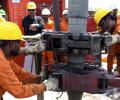
While prices sustaining lower levels is crucial, Govt actions are also a key monitorable given the forthcoming elections in 2024.

Finance Minister Nirmala Sitharaman on Tuesday said the Russia-Ukraine crisis and the ensuing jump in global crude prices are a challenge to financial stability in India. The two issues were discussed at the meeting of Financial Stability Development Council (FSDC), which comprises all the financial sector regulators, Sitharaman told reporters in Mumbai. "It is difficult to say how it (crude prices) will go.
In a marginal relief to consumers, IndianOil, the biggest oil marketing company, has cut petrol prices by Rs 0.56 per litre with effect from midnight today.
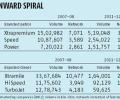
Oil marketing companies decrease distribution & production of fuel brands after huge drop in demand.

In 13 hikes, petrol price has gone up by Rs 7.11 per litre and diesel by Rs 7.67 a litre.

Analysts are enthused by BPCL's upstream foray and have re-rated the stock in the past couple of years.

Centre and state governments are steadily increasing excise duties and value-added tax
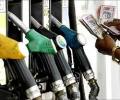
Pattali Makkal Katchi founder S Ramadoss said that Prime Minister Narendra Modi should meet the expectations of the people that prices will go down if he took over and 'it is the duty of the new government to do that.'

OMCs are currently incurring daily under-recovery of Rs 230 crore.

From its recent lows, the stock of consumer major Marico is up 7 per cent on the back of a better-than-expected June quarter performance and robust outlook. In a pre-quarter update, the management indicated that domestic volume growth should witness an improvement in FY25, while other segments (growth portfolio, international business) too would see traction going ahead. The near-term trigger is strong sales and operating performance for Q1FY25.

Corporate India is more dependent than before on exporters of IT services such as Tata Consultancy Services (TCS), Infosys, and Wipro for earning foreign exchange. Such companies account for nearly 43 per cent of the forex revenues of listed firms, up from 22 per cent a decade ago. The listed IT services companies earned nearly Rs 4.2 trillion through exports in FY22, up 15 per cent from the Rs 3.65 trillion a year earlier. In comparison, the forex revenues or exports of the rest of the BSE500 companies were down 11.9 per cent to Rs 5.6 trillion last financial year.

Lower crude oil prices would impact India's inflation, CAD.

In January, India allowed fuel retailers to raise the price of subsidised diesel every month and asked bulk buyers to pay market rates.

Apart from the emotional value attached to buying gold, the yellow metal offers protection against inflation, interest rate spikes, currency and geopolitical risks, says Anamika Pareek.

From the Sensex basket, Mahindra & Mahindra, Maruti, Tata Steel, Bajaj Finserv, Power Grid, Reliance Industries, Axis Bank and JSW Steel were the major gainers. Wipro, Nestle, HDFC Bank and Bajaj Finance were among the laggards.

Sectors that will drive profit growth include refineries, private banks, capital goods, cement, fast moving consumer goods, metals and oil & gas. Sectors with disappointing growth are public sector banks, construction, media, pharmaceuticals, steel, textiles, telecom and tyres.

Markets ended higher, amid firm global cues, and are on track for third straight day of gains.
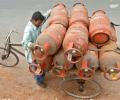
A shortfall in LPG supply from Aramco has led to huge booking backlog across states. To meet the backlog, India has asked Abu Dhabi National Oil Company for two additional cargos of LPG, but that may take another 10 days to reach.

Chinese stock markets suffered their biggest single-day drop since the global financial crisis.

The CBI has booked an ITBP commandant and his two subordinates for alleged corruption in purchase of heating oil and other items for an outpost at Indo-China LAC in Uttarakhand, officials said Tuesday.
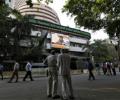
The broader markets also ended lower in line with the benchmark indices

Oil firms yet to get Rs 18,000 crore (Rs 18 billion) of FY12 subsidy compensation, as estimate for this year's underrecovery swells past Budget allocation.

From the Sensex pack, Mahindra & Mahindra climbed 3.71 per cent after the company reported an 18 per cent jump in its consolidated profit for the March quarter and the highest-ever annual profit of Rs 10,282 crore in FY23. Titan, Tata Steel, HDFC, UltraTech Cement, State Bank of India, ITC, IndusInd Bank, NTPC, HDFC Bank and Bajaj Finserv were the other major gainers. HCL Technologies, Power Grid, Maruti, Wipro, Tata Consultancy Services, ICICI Bank, Infosys, Tech Mahindra and Hindustan Unilever were the laggards.
The positive impact of the February 14 hike in petrol and diesal prices on oil marketing companies has been negated in just a fortnight with daily retail losses of these companies going back to over Rs 410 crore (Rs 4.1 billion) for the fortnight ended February 29. This is due to the steep rise in global crude prices in recent days. The retail prices were hiked by Rs 2 per litre for petrol and Re 1per litre for diesel.

Saudis are interested in expanding their relationship with India, given it is becoming the main driver of crude demand growth in Asia

Diesel is currently sold at a loss of over Rs 10.80 per litre.

EM asset classes could rally if the pace of US Federal Reserve rate increases moderates.

The oil companies raised petrol prices by Rs 7.50 on Wednesday, a tough but unpopular decision which many see as a strong signal from the government that it's now stepping on the reform pedal.

The S&P BSE Sensex surged 160 points to close at 25,262.

'Forget your loss or profit in your portfolio.' 'Look at how much cash you have in hand.' 'If you don't have cash in hand, liquidate at least partially; get into about 20 per cent in cash.'
